Learn about manatees
Our captains don't just find manatees. They explain why manatees come to these springs, how a mother cares for her calf, and why a boat strike is the biggest danger they face.
The Florida manatee is a subspecies of the West Indian manatee: a slow, gentle, plant-eating marine mammal that lives in Florida's rivers, bays and springs. Adults are typically 9 to 10 feet long and weigh around 1,000 pounds. Every cooler season, manatees gather in the warm, spring-fed rivers around Homosassa and Crystal River, which is where our captains find them.
Spring water
72°F
The springs stay about 72 degrees all year, which is why manatees crowd in when the Gulf turns cold.
The trigger
68–70°F
When the Gulf drops below this, manatees head for the warm springs, sometimes within a single night.
Lunch, all day
6–8 hrs
How long a manatee spends eating each day, up to 10% of its body weight in seagrass and plants.
Size
~1,000 lb
A typical adult is 9 to 10 feet long. The biggest reach 13 feet and 3,500 pounds.
Ask the captain
Size and body
How much do manatees weigh?
An adult Florida manatee typically weighs about 1,000 pounds, with most between 800 and 1,200 pounds. The biggest reach 3,500 pounds. Newborn calves weigh about 60 to 70 pounds.
How big do manatees get?
Adults are typically 9 to 10 feet long, and some grow to more than 13 feet. Newborn calves are about 4 to 4½ feet long. In the water, even a young manatee is hard to miss.
Are manatees mammals?
Yes. Manatees are marine mammals. They breathe air, give birth to live young, and nurse their calves with milk from teats just behind their flippers.
What animals are manatees related to?
Their closest living relatives are the elephant and the hyrax, a small African mammal. Manatees belong to the order Sirenia, along with the dugong and two other manatee species. The nickname "sea cow" comes from how much of the day they spend grazing.
How long do manatees live?
Manatees can live 60 years or more, but in the wild most don't come close. Research by Florida's wildlife agency found few manatees living past 30, mostly because of boat strikes and other human-related causes.
How long can a manatee hold its breath?
A manatee usually surfaces to breathe every 3 to 5 minutes. While resting, it can stay under for up to 20 minutes. When it's working hard, it may come up every 30 seconds.
How fast can manatees swim?
Usually just 3 to 5 miles per hour. They can sprint at 15 to 20 miles per hour in short bursts, but most of the time they cruise, graze and rest.
Food and habitat
What do manatees eat?
Manatees are herbivores. They graze on seagrass and other aquatic plants for up to 8 hours a day and can eat up to 10% of their body weight daily, roughly 100 pounds of plants for a 1,000-pound adult. Their molars wear down and are replaced throughout their lives.
Do manatees live in fresh water or salt water?
Both. Manatees move freely between salt, brackish and fresh water, including coastal bays, rivers, canals and springs. The Homosassa River is a mix: spring-fed fresh water upstream that flows out to the Gulf.
Why do manatees gather in Florida's springs?
They can't handle cold water. Manatees can't tolerate water below about 68°F for long, so when the Gulf cools below about 70°F they head for warm refuges. Springs stay about 72°F all year, which is why the Homosassa and Crystal Rivers fill with manatees in the cooler months.
Where do Florida manatees go in summer?
They spread out. In the warmer months, Florida manatees travel the state's rivers and coastline, and some range as far as Texas and the Carolinas, with rare sightings as far north as Massachusetts. Mothers with calves and other residents stay around Homosassa all year.
Manatees and people
Are manatees friendly?
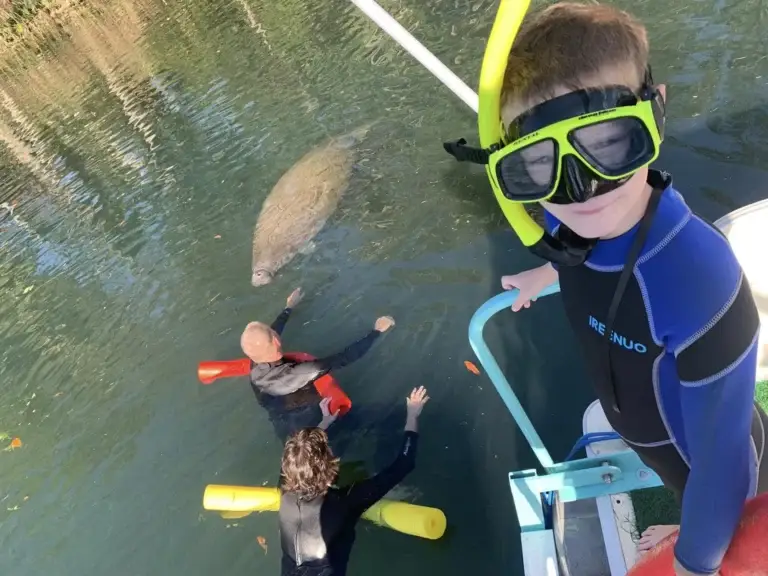
Manatees are gentle, curious and slow-moving, and calm manatees often come over to look at quiet swimmers. Friendly isn't the same as tame, though. They're wild animals, and the best encounters happen when you float still and let the manatee set the distance.
Are manatees dangerous? Do they bite?
No. Manatees aren't aggressive, and they have no front teeth to bite with, only flat molars at the back of the mouth for grinding plants. Even a mother doesn't attack people near her calf. She puts herself between you and the calf, or swims away.
Do manatees like to be petted?
Curious manatees sometimes nuzzle or bump swimmers, but petting isn't allowed. Touching or chasing a manatee in a way that changes its behavior counts as harassment under federal and Florida law. Our rule is simple: look, don't touch. If a manatee touches you, enjoy it, but don't reach out.
What should I do if a manatee touches me?
Stay calm, keep floating and enjoy it. Keep your hands to yourself, and don't grab, hug or follow it. Let the manatee decide when the encounter is over.
Why can't you feed manatees or give them water?
Because it teaches them to approach boats and docks, and that's how they get hurt. Boat strikes are the leading human-related cause of manatee deaths. Feeding or watering a manatee is also illegal harassment.
Calves
When do manatees have babies?
Any time of year, with the most births in spring and summer. A female has one calf every 2 to 5 years after a pregnancy of about a year. Twins are rare.
How long do manatee calves stay with their mothers?
One to two years. During that time the mother nurses her calf and teaches it where to find food, warm-water refuges and safe travel routes.
Do manatees mate for life?
No. Manatees don't form permanent pair bonds, and males take no part in raising the calf. The lasting bond is between a mother and her calf, who call back and forth with squeaks and chirps.
Protection and population
Are manatees endangered?
Florida manatees are listed as threatened under the federal Endangered Species Act. They were reclassified from endangered to threatened in 2017, and conservation groups have petitioned to restore endangered status. They're also protected by the Marine Mammal Protection Act and the Florida Manatee Sanctuary Act.
How many manatees live in Florida?
At least 8,350, according to the U.S. Fish & Wildlife Service, up from a minimum count of 1,267 when aerial surveys began in 1991. Better survey methods account for part of that increase.
What is the biggest threat to manatees?
People. Boat strikes are the leading human-related cause of death, followed by the loss of seagrass and warm-water habitat, entanglement in fishing line and gear, and crushing in canal locks and flood gates. Cold snaps and red tide take a toll too.
The big migration runs mid-October to late April, when migratory manatees arrive and join the residents. But mothers with calves, rehabilitated animals, and a few that simply never leave stay all year. In summer they're spread out along the river and feeding areas instead of close to the springs.
Natural tannins from the surrounding wetlands give the river its tea color, and grazing manatees stir up the bottom. It's natural, living water. It's just not a swimming pool.
Florida manatees are listed as threatened under the federal Endangered Species Act and are protected by the Marine Mammal Protection Act and the Florida Manatee Sanctuary Act. Changing a manatee's natural behavior counts as harassment, even if you mean well. Boat strikes are the biggest human-related danger they face, which is why feeding them or giving them water is off-limits: it teaches them to approach boats and docks.
Sources: U.S. Fish & Wildlife Service (West Indian manatee species profile) and Save the Manatee Club (Manatee Facts). Last reviewed October 2026.
Our goal isn't simply to help you see a manatee. It's to help you understand one.
Book your manatee tour
Every tour is a small boat with six guests or fewer. Choose a tour to see dates and times.
Private, more water time
$585 per boat, up to 6
Departs 8 AM and 1 PM

Private, lunch included
$999 per boat, up to 6
Departs 8 AM
Not sure which one? Compare the tours
More than six in your group? Call 352-257-8687
