Not everyone wants to pull on a wetsuit to meet a manatee. Some travelers want a boardwalk, a cup of coffee and a manatee surfacing below the railing, and Florida has a surprising number of places that deliver exactly that, most of them free or close to it.
The catch is timing. Wild manatees gather at Florida’s warm-water sites in the cold months and spread out when the water warms, so the same boardwalk can be packed with manatees in January and empty in July. This guide lists the main public manatee viewing spots by region, with the season, hours and fees each one publishes.
TL;DR
- Wild manatee viewing in Florida is a winter activity. The Florida Fish and Wildlife Conservation Commission (FWC) says manatees seek warm-water sites as water temperatures drop below 68 degrees.
- Many viewing sites use a manatee season of roughly November 15 to March 31; Tampa Electric’s Manatee Viewing Center opens November 1 to April 15.
- Several of the best spots are free, including Tampa Electric’s Manatee Viewing Center and Manatee Lagoon in West Palm Beach.
- Ellie Schiller Homosassa Springs Wildlife State Park is one of the few places to see manatees in every season, through an underwater observatory, thanks to its resident manatees that can’t be released.
- Outside winter, Save the Manatee Club says your best chance of seeing a manatee is at a rehabilitation facility.
When to go: the cold-weather rule
Florida manatees can’t tolerate cold water for long. According to FWC, “as water temperatures drop below 68 degrees Fahrenheit, Florida’s manatees seek refuge at springs, power plant discharge areas and other warm water sites.” That’s why the most reliable viewing happens on cold mornings from about December through February, often after a few chilly nights in a row.
Save the Manatee Club notes that “from April through October, your best chance of seeing a manatee is at rehabilitation facilities.” In summer, wild manatees disperse along the coast and rivers, and the winter gathering spots can sit nearly empty.
Quick comparison
| Viewing spot | Region | How you view | Season (as published) | Cost (checked October 2026) |
|---|---|---|---|---|
| Blue Spring State Park | Central Florida | Boardwalk to the headspring | Nov 15 to Mar 31 | $6 per vehicle; day-use reservation required |
| Manatee Lagoon, An FPL Eco-Discovery Center | Southeast Florida | Observation deck | Nov 15 to Mar 31 | Free, free parking |
| Tampa Electric Manatee Viewing Center | Tampa Bay | Boardwalks, tidal walk, observation tower | Nov 1 to Apr 15 | Free |
| Lee County Manatee Park | Southwest Florida | Boardwalk and viewing areas | Late December to February is best | Parking $2 per hour or $5 per day |
| Three Sisters Springs boardwalk | Nature Coast | Boardwalk around the springs | Nov 15 to Mar 31 manatee season | $20 adults in winter, $12.50 in summer |
| Ellie Schiller Homosassa Springs Wildlife State Park | Nature Coast | Underwater observatory | Year-round | $13 adults, $5 ages 6 to 12 |
Hours, fees and reservation rules change, so check each site’s official page before you drive.
Central and East Florida
Blue Spring State Park (Orange City)
Blue Spring State Park in Volusia County is one of Florida’s best-known manatee winter refuges. A boardwalk runs about a third of a mile from the St. Johns River to the headspring, and the park reported a record 729 manatees in 2023. During manatee season, November 15 to March 31, Florida State Parks says “swimming and all other water activities in the spring run are prohibited,” so this is a look-from-the-boardwalk experience. The park is open 8 a.m. to sunset, entry is $6 per vehicle, and since July 15, 2026 a day-use reservation has been required. Florida State Parks notes it frequently reaches capacity and may temporarily close.
Manatee Lagoon, An FPL Eco-Discovery Center (West Palm Beach)
Manatee Lagoon overlooks the warm-water outflow of Florida Power and Light’s Riviera Beach Next Generation Clean Energy Center, where manatees gather in winter. Admission and parking are free. It’s open 9 a.m. to 4 p.m., daily during manatee season (November 15 to March 31) and closed Mondays the rest of the year. The center is upfront that there’s “no guarantee you will spot a manatee.”
Tampa Bay and Southwest Florida
Tampa Electric Manatee Viewing Center (Apollo Beach)
Tampa Electric’s Manatee Viewing Center sits beside the discharge canal of the Big Bend Power Station, which is a state and federally designated manatee sanctuary. Boardwalks, a tidal walk and an observation tower look over the canal. The center is open daily from November 1 to April 15, 10 a.m. to 5 p.m., with free parking and admission. For the 2026 to 2027 season it reopens November 1, 2026.
Lee County Manatee Park (Fort Myers)
Lee County Manatee Park is a non-captive warm-water refuge on a canal fed by a power plant outflow, with boardwalks, viewing areas and a kayak launch. Lee County says the best viewing months are late December, January and February, when Gulf water drops below 68 degrees, and that manatees are generally not present from April to early December. Parking is $2 per hour or $5 per day.
The Nature Coast: Crystal River and Homosassa
Citrus County, north of Tampa on the Gulf coast, is home to the Crystal River National Wildlife Refuge and the spring-fed Crystal and Homosassa rivers, where manatees gather in large numbers in cold weather.
Three Sisters Springs boardwalk (Crystal River)
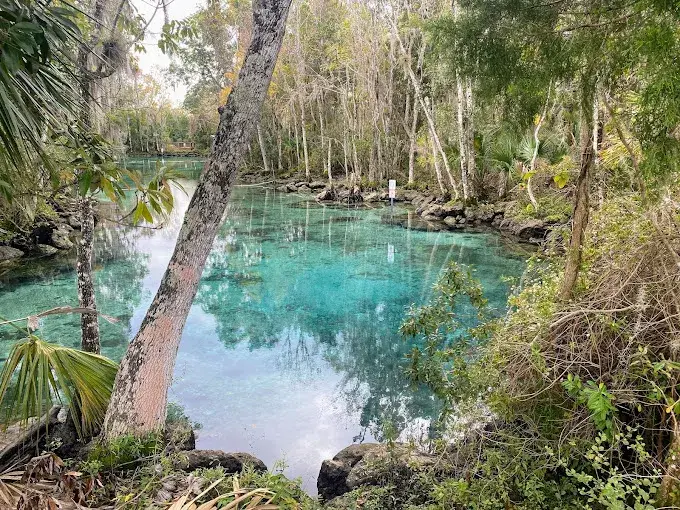
Three Sisters Springs is part of the Crystal River National Wildlife Refuge, and land access is managed by the City of Crystal River’s Three Sisters Springs Center. There’s no public parking at the springs: visitors buy a ticket that includes a shuttle, or walk or bike in, and the boardwalk is open 8:30 a.m. to 4:30 p.m. Tickets are $20 for adults from November 15 to March 31 and $12.50 the rest of the year, $7.50 for children 6 to 15, and free for kids 5 and under. There’s no swimming from the boardwalk, and parts of it have been under construction, so check the city’s page before you go. For how in-water visits work at Three Sisters, see our Three Sisters Springs guide.
Ellie Schiller Homosassa Springs Wildlife State Park (Homosassa)
At Ellie Schiller Homosassa Springs Wildlife State Park, an underwater observatory called the Fish Bowl sits in the main spring, giving an eye-level view of fish and manatees below the surface. FWC lists the park as having resident manatees year-round, and wild manatees can reach the headwaters in winter. The park holds manatee programs featuring its non-releasable resident manatees daily at 11 a.m. and 1 p.m. (check the park’s schedule), is open 9 a.m. to 5:30 p.m., and charges $13 for adults and $5 for children 6 to 12. In February 2026 the park suspended its shuttle boat service because of low water levels, so check its current status before visiting.
Hunter Springs Park (Crystal River)
Hunter Springs Park is a small city park on Kings Bay with a boardwalk and a roped swim area. The City of Crystal River says visitors “may even spot manatees swimming by, especially in colder months.” It’s a casual spot rather than a dedicated viewing site.
Other places on FWC’s viewing list
FWC’s own list of manatee viewing sites includes several more spots worth a look, especially if you’re already nearby. Call ahead for current conditions.
- Edward Ball Wakulla Springs State Park, near Tallahassee, where manatees can be seen from the diving platform or tour boats
- Manatee Springs State Park in Chiefland, where manatees use the spring and spring run in winter
- Merritt Island National Wildlife Refuge, from the platform overlooking Haulover Canal
- The Manatee Observation and Education Center in Fort Pierce
- Spring Bayou in Tarpon Springs, from November through May
Seeing manatees outside winter
From spring through fall, wild manatees spread out and the winter refuges thin out. Save the Manatee Club points visitors to rehabilitation facilities from April through October, and FWC’s viewing list includes ZooTampa, Mote Marine Laboratory in Sarasota, SeaWorld Orlando and The Seas at Epcot. Homosassa Springs’ underwater observatory also remains an option year-round.
Viewing manatees responsibly
Wherever you watch, give manatees space. Florida manatees are protected under federal and state law, which prohibit harassing them, so keep your distance, keep noise down and never feed them or give them water. For how these rules work in the water, see Manatee Manners.
Want to get in the water instead?
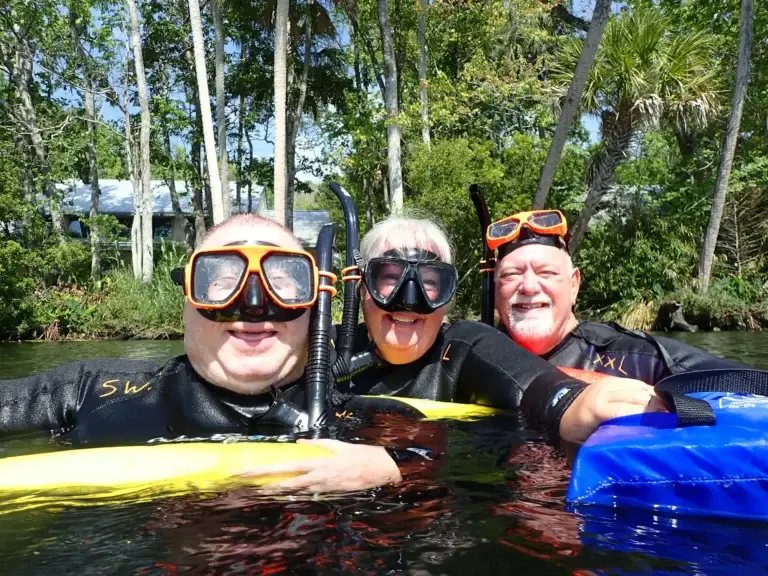
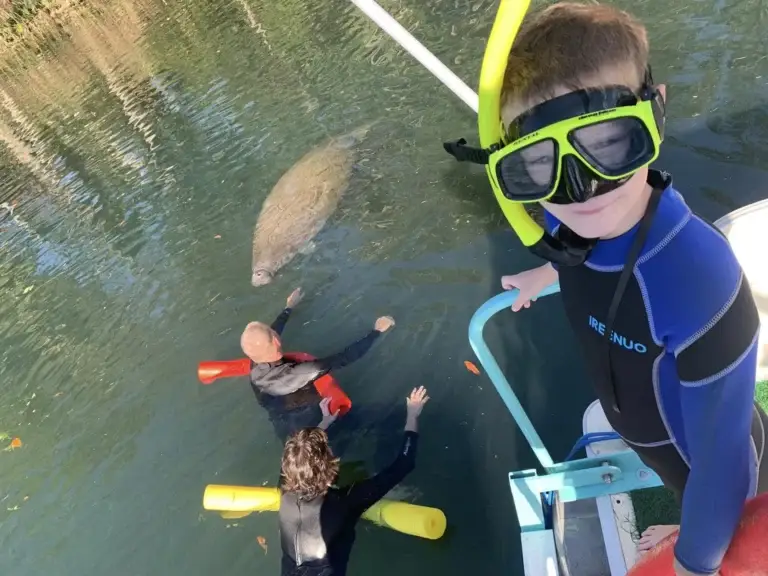
Viewing from a boardwalk and floating beside a manatee are different experiences. If you’d like the second, Swim With Manatees, a small-group manatee snorkel tour company on the Homosassa River in Citrus County, takes up to six guests per boat to meet wild manatees year-round, with the biggest numbers in the cooler months. The tours leave from Monkey Island Riverside Resort, also in Homosassa, so a tour and Ellie Schiller Homosassa Springs Wildlife State Park fit in the same day.
FAQ
What is the best month to see manatees in Florida?
Wild manatees gather at warm-water sites in the coldest months. Lee County, for example, names late December, January and February as its best viewing months, and many sites run their manatee season from mid-November to the end of March.
Where can you see manatees for free in Florida?
Tampa Electric’s Manatee Viewing Center in Apollo Beach and Manatee Lagoon in West Palm Beach both offer free admission and free parking during manatee season.
Can you see manatees in Florida in summer?
Yes, but less reliably in the wild. Save the Manatee Club says rehabilitation facilities are your best chance from April through October, and Ellie Schiller Homosassa Springs Wildlife State Park has manatees year-round.
Can you swim with manatees at Blue Spring State Park?
No. Florida State Parks prohibits swimming and all other water activities in Blue Spring’s spring run during manatee season, November 15 to March 31.
The bottom line
For wild manatees from land, go in winter, on a cold morning, to a warm-water site: Blue Spring, Apollo Beach, West Palm Beach, Fort Myers or the springs of Crystal River and Homosassa. For a year-round sure thing, Homosassa Springs’ underwater observatory is hard to beat. Check each site’s official page for current hours before you go.