Learn about manatees
Here's the most important thing we teach: you don't approach the manatee. The manatee approaches you. Everything else on this page follows from that.
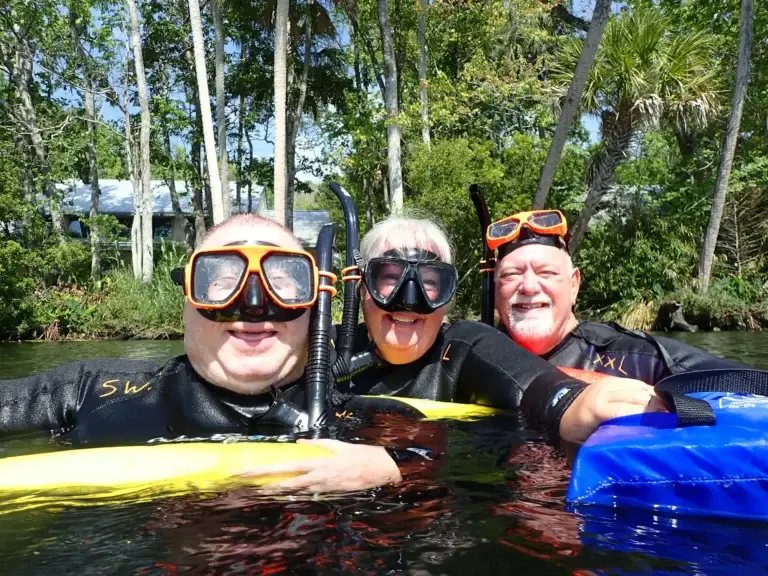
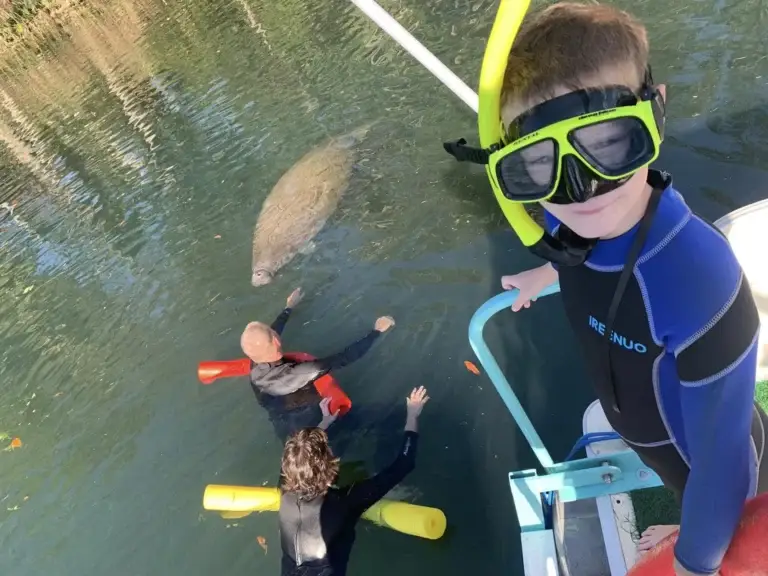
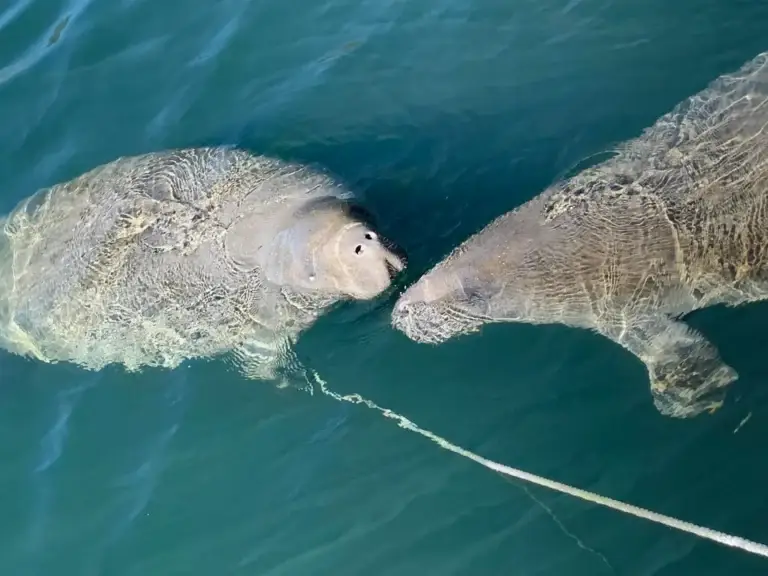
People call it "swimming with manatees," but there's very little swimming involved. You slip into the water quietly, float on the surface with your group, and wait. Manatees are curious. When they're comfortable, they'll often come over for a closer look. Sometimes they drift right under you. Sometimes a calf will bump you.
When that happens, let it happen. Keep your hands to yourself and enjoy it. A wild animal that chooses to come close is a much better moment than one you chased down.
This is what the manatee folks call a passive, or "soft," in-water encounter. It works better for you and for the manatee.
If you swim hard at a manatee, it leaves, and you're left floating in its wake staring at empty water. Same thing if a boat roars up to it. Splashing, kicking and diving all end an encounter fast.
Float calmly, stay together as a group so the manatee can keep track of everyone, and let it set the distance, the pace and how long it stays. Using that approach, our guests have had encounters that last from a few minutes to well over an hour.
The rules in the water
Florida manatees are listed as threatened under the federal Endangered Species Act and are protected by the Marine Mammal Protection Act and the Florida Manatee Sanctuary Act. Changing a manatee's natural behavior counts as harassment, even if you mean well. So:
01
Look, don't touch.
If a manatee touches you, enjoy it, but don't reach out.
02
Don't chase.
Don't chase, surround or corner a manatee.
03
Mother and calf.
Never come between a mother and her calf.
04
Let resting manatees rest.
If one is sleeping on the bottom, leave it be.
05
No feeding.
And no giving them water. It teaches them to approach boats and docks, which is how they get hurt.
06
Stay on the surface.
No diving down to them, and no scuba.
07
Respect the white ropes.
Marked sanctuaries are closed to people so manatees have somewhere quiet to rest. Your captain will guide you whenever we're near the sanctuary ropes. The Homosassa River system also offers a larger area to swim with the manatees than the refuge.
08
Slow and quiet.
No splashing, and no fins.
Your captain covers all of this before you get in the water.
Yes. You may have read online that Crystal River is the only legal place to swim with manatees in Florida. It isn't. The Crystal River National Wildlife Refuge has its own permit system and rules for tours inside the refuge. The Homosassa River, where we operate, is outside the refuge, and passive encounters there are legal under the same federal and state protections that apply everywhere manatees live.
On our boats
We share these docks and this river with neighbors, other boats and a lot of manatees. 99% of our guests never need this list. For the other 1%:
No heavy drinking, and no showing up already there.
No littering. If you brought it, it goes home with you.
No loud music or yelling. The manatees can hear you.
Respect the crew and the captain, and follow the safety briefing.
Watch the language. There are kids aboard.
Please leave family arguments at the dock. They'll be there when you get back.
Any of these can end a tour early, for everyone's sake.
We've been doing this for 26 years, long enough to see what crowds and chasing do to manatees. It's why we keep our boats to six guests, why we operate on the quieter Homosassa River, and why our captains spend as much time teaching as they do driving. A calm manatee is a curious manatee, and a curious manatee is the whole point.
That's how you leave with a story instead of a photo of a tail.
Book your manatee tour
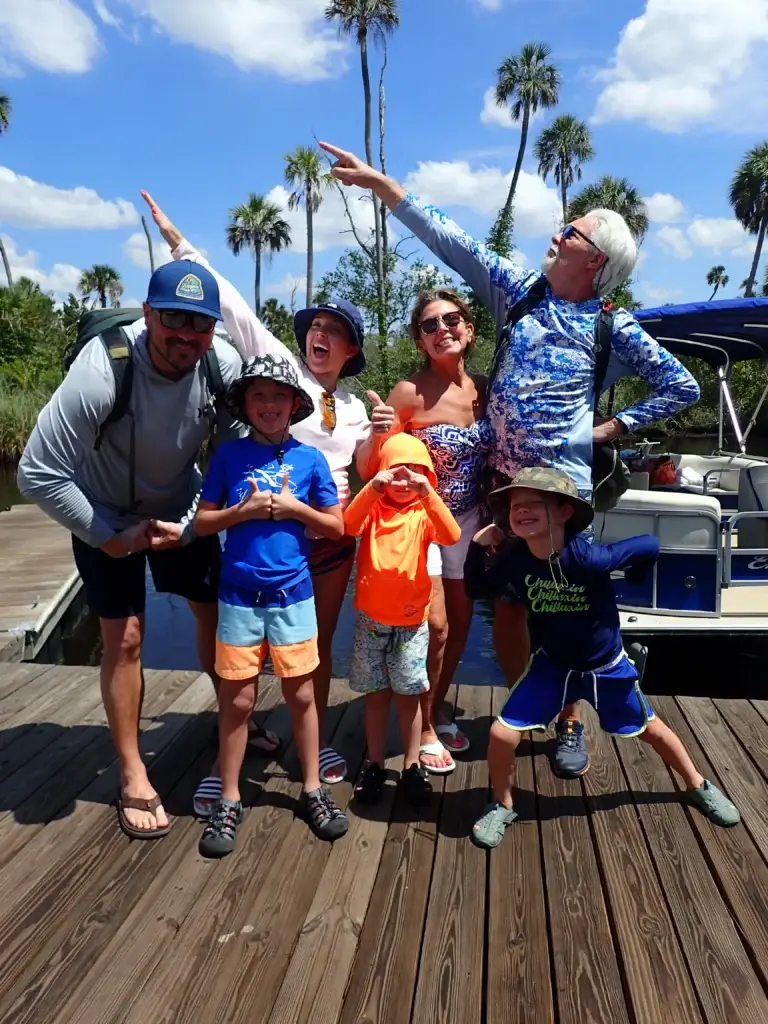
Every tour is a small boat with six guests or fewer. Choose a tour to see dates and times.
Private, more water time
$585 per boat, up to 6
Departs 8 AM and 1 PM
Private, lunch included
$999 per boat, up to 6
Departs 8 AM
Not sure which one? Compare the tours
More than six in your group? Call 352-257-8687
