New study, November 2026
Government water data shows why manatees gather on the Homosassa River every winter. When the Gulf turns cold, Homosassa Springs holds in the low 70s.
Swim With Manatees, Homosassa, Florida. Published November 18, 2026. Gulf data through November 10, 2026; spring temperature through October 1, 2025; spring flow through November 10, 2026.
What the numbers show
At NOAA's Cedar Key station, the daily average Gulf water temperature fell below 68°F on 86 to 107 days in each of the last five winters (November through March). The Florida Fish and Wildlife Conservation Commission (FWC) identifies 68°F as the point where long exposure puts manatees at risk of cold stress.
The U.S. Geological Survey monitor at the main spring recorded a daily average between 73.2°F and 76.5°F on every day it reported from June 2016 to October 2025.
On December 26, 2022, the Gulf at Cedar Key averaged 46.7°F and the spring averaged 73.9°F. Across all 466 days from 2021 to 2025 when the Gulf was below 68°F and both monitors reported, the spring held between 73.2°F and 74.3°F.
The 2025-26 winter had 107 days below 68°F at Cedar Key, the most of the five full winters measured, and the lowest daily average in the record: 43.3°F on February 2, 2026.
Spring discharge averaged 78.5 cubic feet per second in 2026 through November 10, about 50.8 million gallons a day. That is 15 percent below the 1996 to 2005 average of 92.6 cubic feet per second.
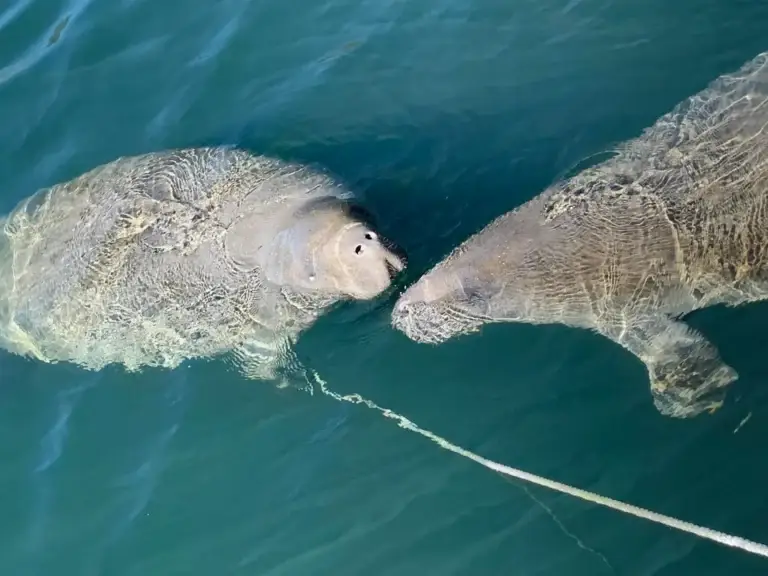
Florida manatees are warm-water animals. When the Gulf turns cold, they move to water that stays warm, and natural springs are among the most important of those places. The numbers above show why the Homosassa River draws them: in the same weeks the Gulf sits in the 40s and 50s, the spring pours out water in the low 70s, day after day.
That is also why winter is manatee season for visitors. The animals arrive on their own schedule, set by water temperature, and spread back out as the Gulf warms.
Gulf readings from NOAA station 8727520 at Cedar Key; spring readings from USGS station 02310678 at Homosassa Springs.
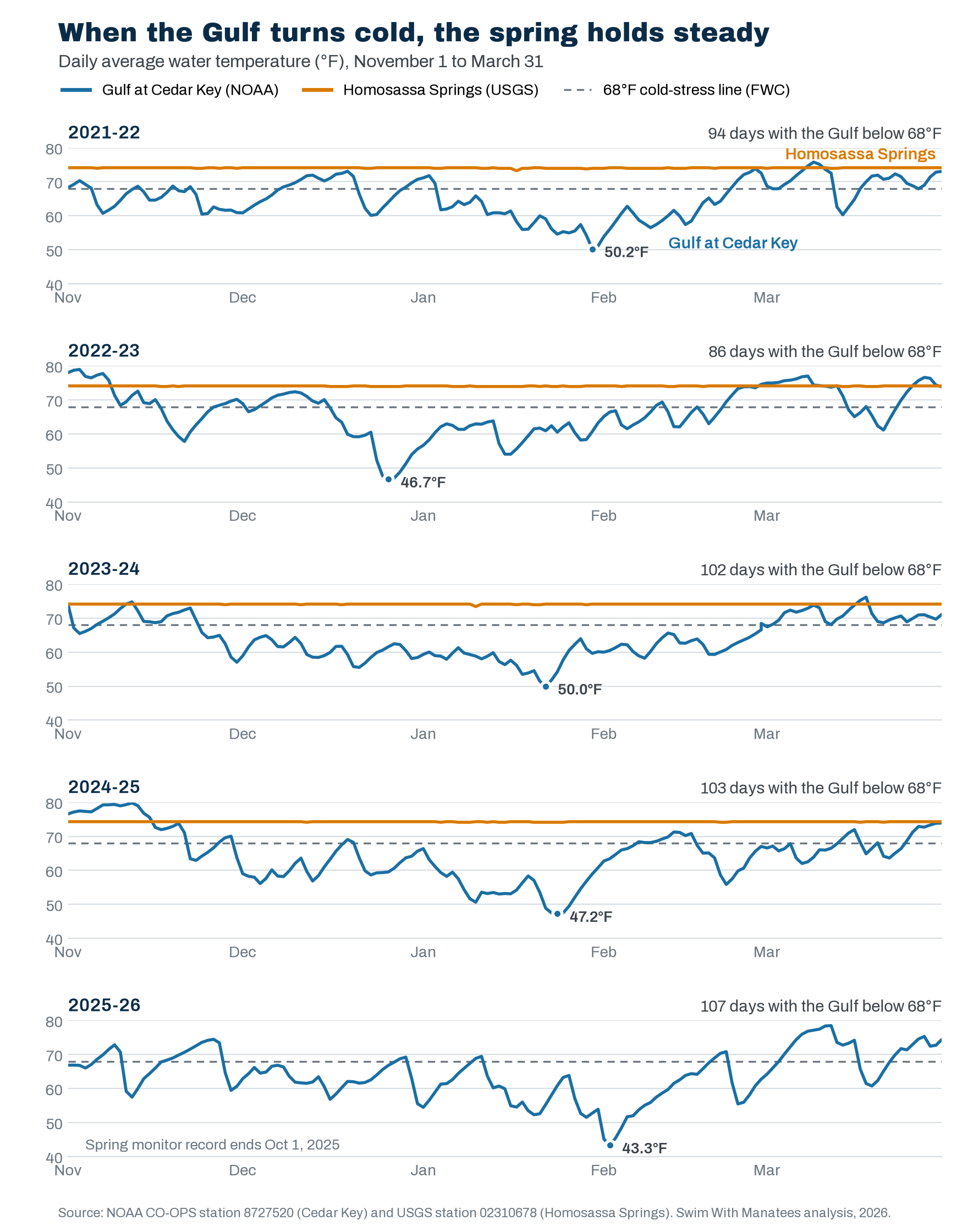
Daily average water temperature, November 1 to March 31. Gulf at Cedar Key: NOAA station 8727520. Homosassa Springs: USGS station 02310678, whose temperature record runs through October 1, 2025.
94 of 150 days with the Gulf below 68°F, 26 below 60°F. Coldest Gulf day: 50.2°F on January 30, 2022, with the spring at 73.9°F. Average Gulf temperature: 65.1°F.
86 of 151 days below 68°F, 24 below 60°F. Coldest Gulf day: 46.7°F on December 26, 2022, with the spring at 73.9°F. Average Gulf temperature: 66.3°F.
102 of 152 days below 68°F, 45 below 60°F. Coldest Gulf day: 50.0°F on January 22, 2024, with the spring at 74.1°F. Average Gulf temperature: 64.0°F.
103 of 151 days below 68°F, 47 below 60°F. Coldest Gulf day: 47.3°F on January 24, 2025, with the spring at 74.1°F. Average Gulf temperature: 64.5°F.
107 of 151 days below 68°F, 39 below 60°F. Coldest Gulf day: 43.3°F on February 2, 2026. The spring temperature record ends October 1, 2025, so this winter has Gulf data only. Average Gulf temperature: 64.1°F.
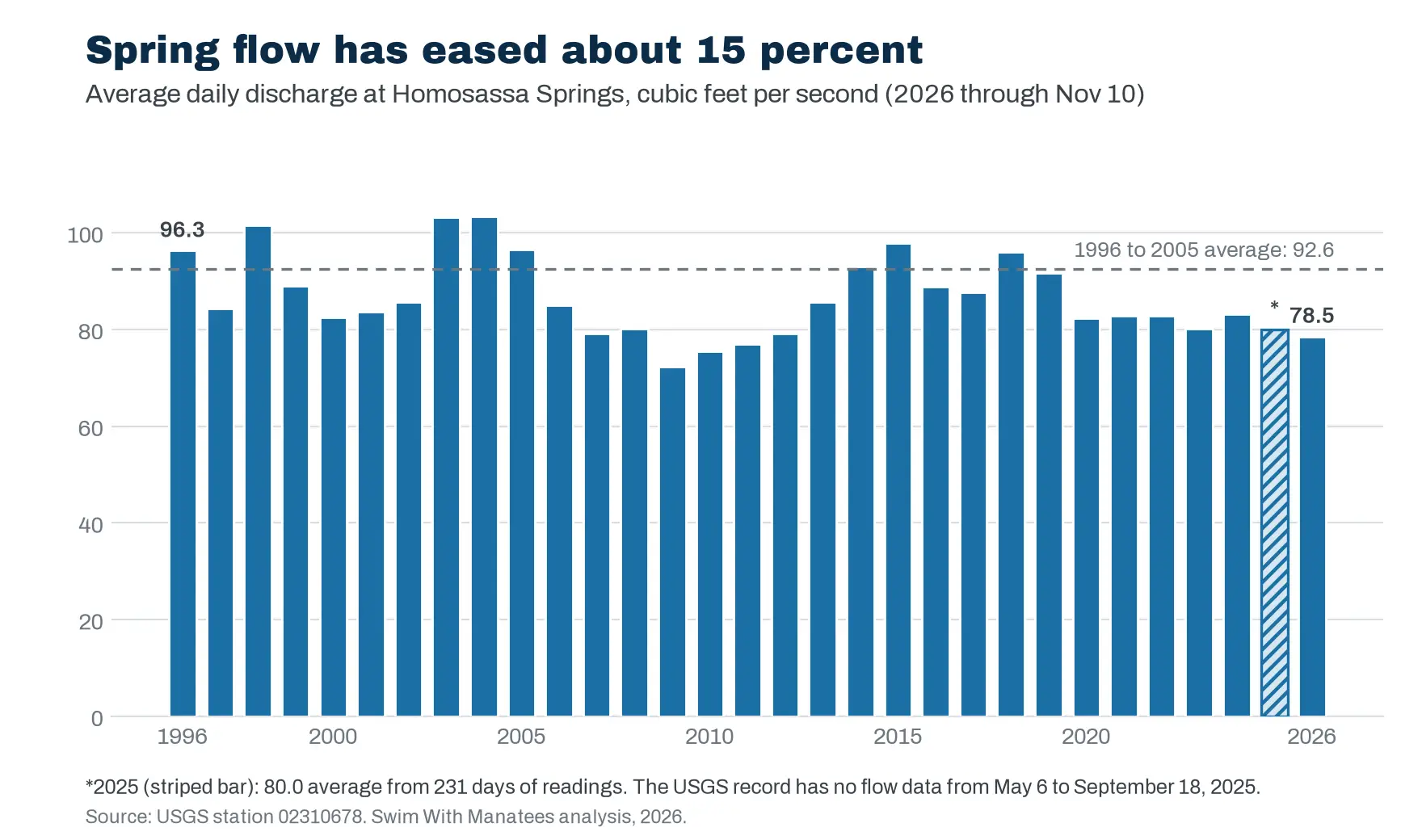
Average daily discharge at Homosassa Springs, USGS station 02310678. The striped 2025 bar averages 231 days of readings, since the USGS record has no flow data from May 6 to September 18, 2025; 2026 runs through November 10.
Lowest daily average 73.2°F and highest 76.5°F, June 2016 to October 1, 2025. On the 466 days the Gulf was below 68°F (January 2021 to October 2025), the spring held between 73.2°F and 74.3°F.
1996 to 2005: 92.6 cubic feet per second, about 59.9 million gallons a day. 2016 to 2025: 85.9 cubic feet per second, about 55.5 million gallons a day. 2026 through November 10: 78.5 cubic feet per second, about 50.8 million gallons a day.
The Gulf at Cedar Key fell below 68°F on November 14, 2026, with a daily average of 67.4°F, and averaged 62.8°F on November 17.
The same cold that brings manatees to the spring can hold them there. FWC reported elevated manatee deaths in the Homosassa River during the cold winter of early 2025. In FWC's account, the cold likely kept more manatees near the warm water for longer, away from seagrass, and many fed on macroalgae instead, which can trigger lethal bacterial toxins. FWC reports that the elevated deaths ended in April as the weather warmed.
Where a death is recorded tells only part of the story. FWC maps each carcass where it is recovered, and the U.S. Fish and Wildlife Service notes that a recovery location can differ from where an animal died or was injured. Master Captain Gene Parker adds that manatees cold-stressed or hurt in other waters often make their way to the springs, so deaths recorded on the river can include animals whose trouble began somewhere else.
Spring flow is also lower than it was 20 to 30 years ago. Both facts are part of why the springs need protecting, and why Swim With Manatees keeps its tours passive: guests float at the surface, give manatees room, and let the animals choose how close to come.
Watch the Gulf forecast. The coldest stretches at Cedar Key, with the Gulf in the 40s and low 50s, fell between late December and early February in all five winters.
Wear the wetsuit. Snorkelers float quietly to watch the manatees, so their bodies make little heat of their own. A wetsuit keeps them warm, adds buoyancy as a flotation aid (separate from a flotation device), and lets them stay in the water longer.
Respect the sanctuaries. From November 15 to March 31, federal manatee sanctuaries are closed to all boating, swimming and other water activity, including the Blue Waters sanctuary at the head of the Homosassa River. Swim With Manatees guides keep a respectful distance from the sanctuary markers.
Manatees set the schedule. They arrive with the cold and spread out as the Gulf warms, which is why November through March is peak season.
Swim With Manatees runs small-group tours on the Homosassa River, next door to the Crystal River refuge: six guests aboard a spacious boat rated for 10 to 12 passengers. Guests can join the manatees in the water for passive observation or watch from the comfort of the boat. See our tours.
NOAA CO-OPS Tides and Currents, station 8727520 (Cedar Key, FL), hourly water temperature, local standard time, January 1, 2021 to November 10, 2026.
USGS National Water Information System, station 02310678 (Homosassa Springs at Homosassa Springs, FL), daily mean water temperature (bottom sensor, converted from °C) and daily mean discharge.
FWC, 2025 Manatee Mortality in Review (68°F cold-stress threshold; Homosassa River mortality in winter 2025).
FWC Fish and Wildlife Research Institute, Manatee Carcass Recovery Locations in Florida (records carcass recovery or verification locations).
U.S. Fish and Wildlife Service, Federal Register, April 7, 2005: a carcass recovery location can differ from the exact location of death.
50 CFR 17.108: federal manatee sanctuaries closed to all waterborne activities November 15 to March 31; Federal Register, November 8, 2002 (Blue Waters sanctuary, Homosassa River headwaters).
NOAA and USGS data pulled November 11, 2026; season-start Gulf readings pulled November 18, 2026.
Gulf daily average: the mean of that day's hourly readings, counted only on days with at least 18 hourly readings.
Winter: November 1 to March 31. The partial 2020-21 winter sits outside the five-winter findings.
Days below 68°F: winter days with a Gulf daily average below 68.0°F.
Spring-minus-Gulf gap: the spring daily average minus the Gulf daily average on the same date.
Gallons per day: cubic feet per second × 646,317.
Flow change: 78.5 ÷ 92.6 − 1 = −15.2 percent.
Cedar Key is a Gulf station about 35 miles northwest of the spring, measured from station coordinates. It represents Gulf conditions on this stretch of coast; water just off the Homosassa River mouth can differ.
The USGS spring temperature record ends October 1, 2025, and has gaps on some days. The 2025-26 winter has Gulf data only.
These are temperature and flow measurements. Water clarity, nutrients and bacteria sit outside this study.
Five full winters is a short record. The study reports each winter and makes no climate-trend claim.
We also tested whether weeks with a colder Gulf drew more Google searches for manatee swims. Compared within the same month, they drew about the same interest, so search data sits outside the findings.
Free to cite with a link to this page. Suggested citation: "Swim With Manatees, The 73-Degree Refuge (2026), using NOAA and USGS data." Journalists and researchers can request the paired daily dataset through our contact page.
Manatees are at risk of cold stress after long exposure to water below 68°F, according to FWC. Springs like Homosassa stay in the low to mid 70s year-round, so manatees move to them when the Gulf cools.
On the coldest Gulf days of the last five winters, the spring ran 23 to 27 degrees warmer. The widest gap in the record was December 26, 2022: 46.7°F in the Gulf at Cedar Key and 73.9°F at the spring.
At Cedar Key, the 2025-26 winter had 107 days below 68°F, the most of the five winters measured, and the coldest daily average in the record, 43.3°F on February 2, 2026.
They come and go with the temperature, and they spread out as the Gulf warms in spring.
About 50.8 million gallons a day on average in 2026, based on USGS flow data. That is lower than the roughly 60 million gallons a day averaged from 1996 to 2005.
NOAA's Cedar Key water temperature station, the USGS monitor at Homosassa Springs, and FWC's 2025 mortality review, all public. The full method is above.
See the warm-water refuge for yourself, in the water or from the boat.
Book your manatee tour
Every tour is a small group of six guests or fewer, with plenty of room to spread out. Choose a tour to see dates and times.
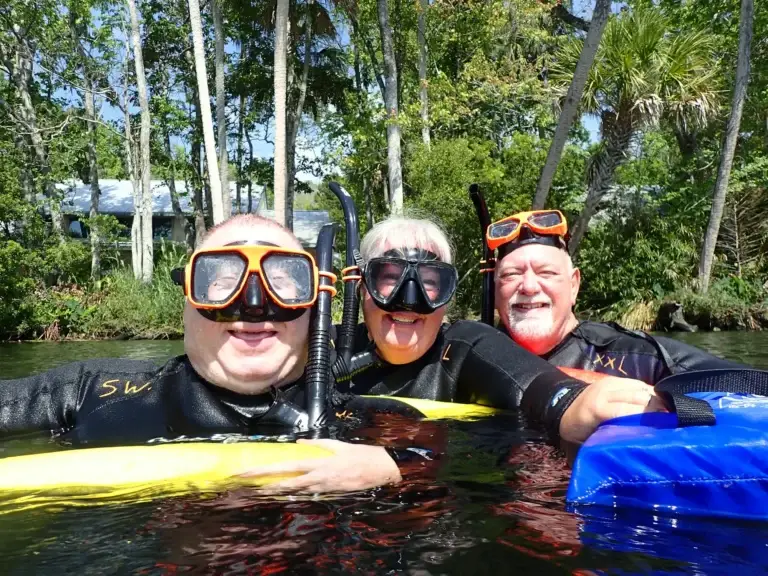
Most popular
From $81 per person + tax and fees
Departs 8, 10, 12 and 2
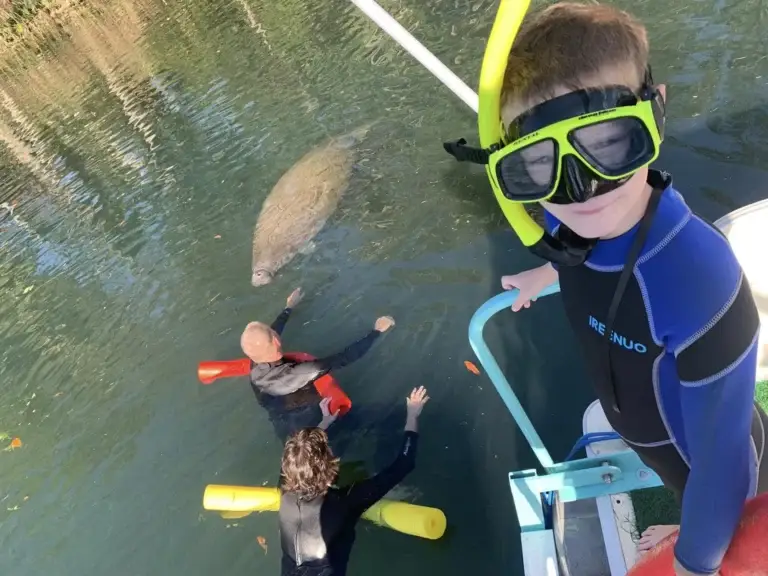
Private
$450 per boat + tax and fees, up to 6
Groups up to 24 on 4 boats
Departs 7, 10 and 1
Private, more water time
$585 per boat + tax and fees, up to 6
Groups up to 24 on 4 boats
Departs 8 AM and 1 PM
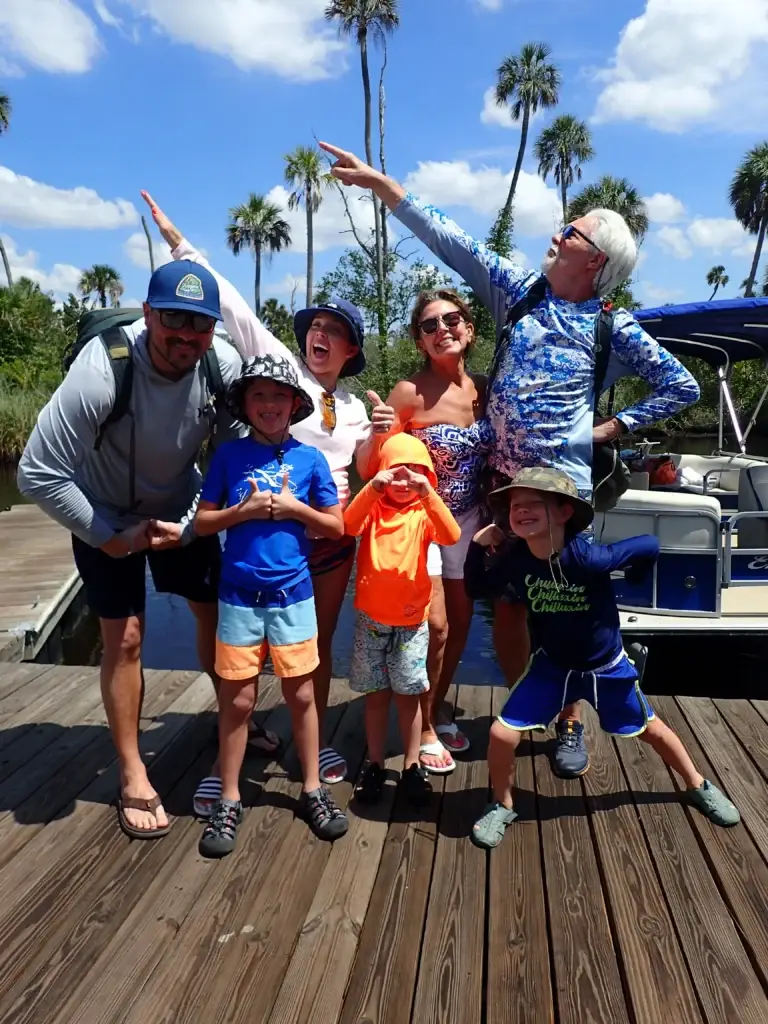
Private, lunch included
$1,029.99 per boat + tax and fees, up to 6
Groups up to 24 on 4 boats
Departs 8 AM
Not sure which one? Compare the tours
More than six in your group? Call 352-257-8687
